
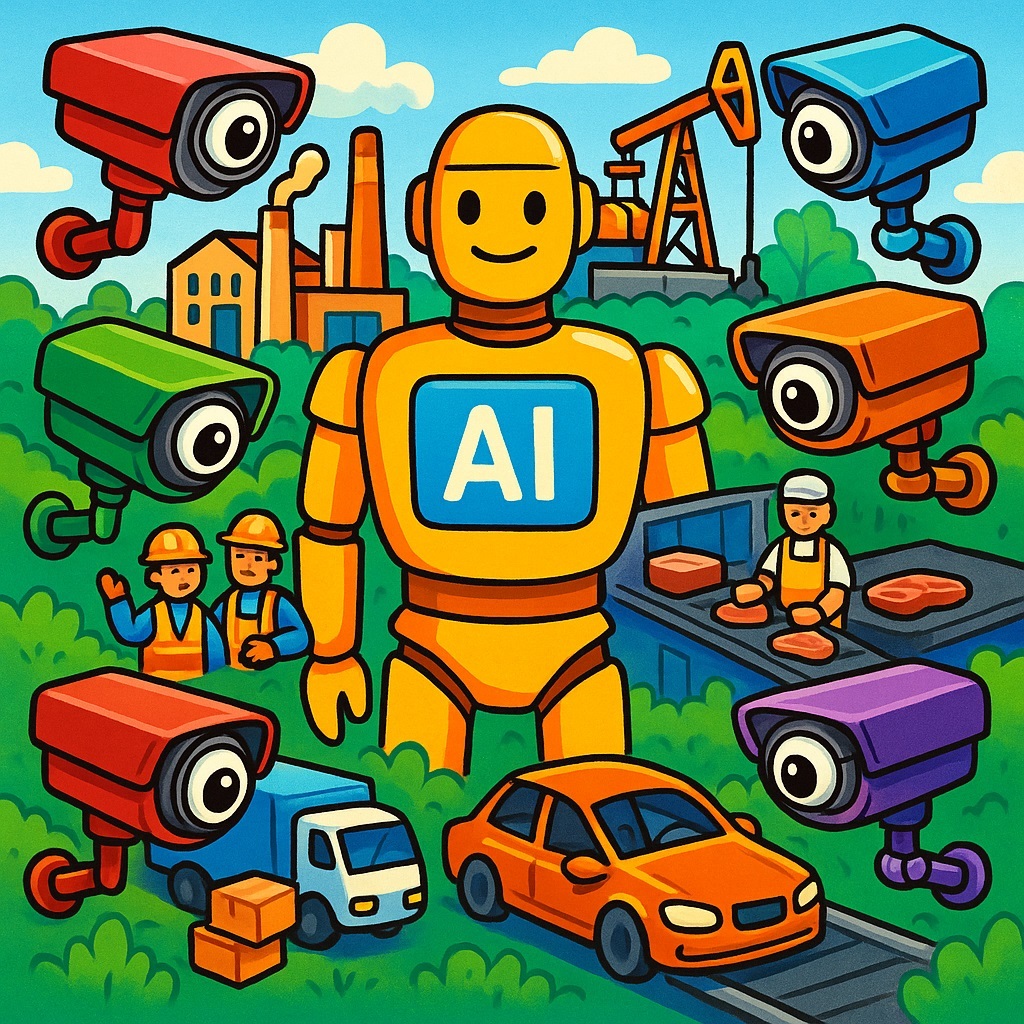
The industrial world is stepping into its biggest transformation in a century — and it’s not about bigger engines or faster conveyors. Today the most valuable resource isn’t steel or electricity. It’s data. Machines aren’t just tools anymore; they’re storytellers, constantly generating signals about their condition, their performance, and their failures.
In this environment, AI isn’t some mystical overlord handing down miracle predictions. It’s a thinking layer — a way to turn raw signals into decisions, telemetry into forecasts, and routine logs into actionable insight.
If the early 2010s were about automation, the 2020s are about intelligence. But the road from “we’ve installed cameras” to “we’re running predictive analytics” is rarely linear. Across industries, the pain points look surprisingly similar: fragmented systems, spotty data, manual workflows, little historical traceability, and an overall lack of analytical culture.
Data First: No Vision Without Observation
The core issue for most industrial sites is simple: there is no trustworthy data. You can walk through a facility filled with PLCs, sensors, motors, and miles of cable — and still find logs with lines like “operated normally” or “no issues detected.”
AI won’t help here. Models don’t guess; they learn by example. Without data, they’re decorative.
A practical starting point looks deceptively simple:
- Install a basic observation layer — cameras plus essential vibration/temperature/pressure sensors.
- Ensure continuous recording.
- Make the data consistent and historically preserved.
The hardware cost is often modest. The real challenge is discipline. Without stable, high-quality data streams, any “smart system” quickly becomes an expensive dashboard with no substance.
Modern Video Analytics: Turning Cameras Into Industrial Vision
Industrial video surveillance has existed for decades. Only recently has it shifted from passive monitoring to active understanding.
Computer vision now identifies behaviors, conditions, and anomalies in real time:
- In metallurgy — flame events, worker proximity to hazardous zones.
- In machining — sequence adherence and assembly precision.
- In food production — hygiene compliance and surface cleanliness.
- In logistics — traffic flow, queue formation, and idle-time metrics.
And the best part? The barrier to entry is extremely low: most facilities already have cameras. Add an analytical layer and suddenly you’re not just “watching” — you’re measuring.
AI processes hundreds of frames per second. It spots missing helmets, improper glove usage, smoke, fire, machine stoppages, forgotten tools, and all sorts of deviations long before a human would react. It doesn’t get tired or distracted.
For shop managers, this changes everything: data becomes objective, consistent, and analyzable.
Quality Control: Goodbye Sampling, Hello Full-Stream Inspection
Quality used to rely on sampling. Now it’s feasible to inspect every item.
A camera with an AI model can detect micro-cracks, misaligned seals, faint discoloration, weak solder joints, or tiny packaging defects — all invisible to the human eye.
This approach is already standard in food and pharma. In mechanical and textile manufacturing, customers increasingly require it.
The tech stack is straightforward:
- A camera
- Controlled lighting
- A trained model
The effect, however, is huge: full-stream inspection reduces scrap, cuts human variability, and builds a digital trace for every batch.
Predictive Maintenance: From Calendar Schedules to Real Condition
Preventive maintenance is useful — and outdated. It’s based on time, not reality.
AI-driven predictive maintenance uses vibration, temperature, pressure, and current signatures to catch failures early. A bearing’s tone changes before it fails. A motor’s spectral vibration shifts before overheating. A pump starts drawing irregular current before seizing.
No magic — just math applied well.
This moves plants from “fixing by schedule” to “fixing by need,” reducing downtime and stabilizing output.
Energy Efficiency: AI vs. Industrial Inertia
The second-largest source of losses in many plants isn’t scrap or accidents — it’s bad energy habits.
Compressors run overnight. HVAC fights itself. Idle machines consume like they’re working overtime.
AI models can track patterns, optimize cycles, and reduce consumption without touching the hardware. Savings of 20–30% aren’t unusual.
This isn’t “smart home tech.” It’s industrial logic with precision.
Safety: From Recording Incidents to Preventing Them
Traditional safety systems react after the fact: someone stepped into a restricted area — and the system logs it. Too late.
AI-driven safety reverses the timeline.
Computer vision can detect unsafe approach trajectories, missing PPE, abnormal inactivity, or risky postures. Thermal analytics identify smoke, overheating metals, and early flame signatures. Models can distinguish welding from actual fire — something most humans fail at under pressure.
In high-risk industries, this doesn’t just prevent downtime — it saves lives.
Small Factories: Intelligence Without Capital
Small manufacturers often operate on thin budgets and even thinner staffing — but ironically, they benefit most from simple AI tools.
Two cameras + one vibration sensor + a modest computer is often enough to:
- Track machine utilization
- Spot process deviations
- Measure idle time
- Estimate scrap sources
- Generate automatic shift reports
No expensive ERP. No complex integration. Just practical visibility.
This is digitalization without the enterprise price tag — industrial minimalism.
Integration: Breaking Down Data Islands
A universal industrial headache: everything is siloed.
Video on one server. SCADA somewhere else. Excel dashboards drifting around like digital tumbleweed.
AI shines only when these islands connect. True value appears when video, telemetry, logistics, and planning feed into one another.
Example workflow:
Camera detects conveyor stoppage → AI flags the MES → production schedule adjusts → ERP updates shipment timelines.
That closed loop is the beginning of a digital twin — but only worth implementing once the data foundation is solid.
The Sensible Roadmap: From Cheap Wins to Complex Systems
Digital transformation fails when companies try to do everything at once. The winning pattern is incremental:
- Observation: Cameras, sensors, data storage.
- Local intelligence: Vision analysis, vibration monitoring, energy models.
- Cross-system analytics: Predictive scenarios, MES/ERP integration.
- Digital twin: Full virtual model with real-time updates.
This evolution takes years, but the order is essential.
Real Pain Points, Real Fixes
- Metallurgy: Overheated crane bearings → add vibration sensors → failures drop 70%.
- Food industry: Missing gloves and caps → video PPE detection → full compliance.
- Warehousing: Lost pallets → AI tracking → zero losses.
- Agriculture: Uneven irrigation → drone/imagery analysis → +15% yield.
Where data flows, intelligence follows.
Deployment Priorities
Start with:
- Data collection
- Video analytics
- Predictive maintenance
- Quality control
- Energy optimization
- Safety monitoring
Defer until ready:
- Full-scale logistics optimization
- End-to-end digital twins
- Autonomous control loops
All advanced features rely on stable, unified data.
The Human Factor
The biggest obstacle isn’t technology — it’s people.
Engineers worry about being replaced. Supervisors fear surveillance misuse. Managers dread infinite pilot projects.
The cure: transparency and incremental rollout. AI is a tool, not a judge. It reduces mistakes; it doesn’t evaluate employees.
Where this mindset takes hold, adoption becomes natural.
Economics: Why the ROI Is Surprisingly Good
Experience shows:
- Up to 70% fewer failures
- 25–40% productivity growth
- 15–25% lower energy use
- 30–50% scrap reduction
- Payback: 3–12 months for basic systems
All achievable without megaproject budgets.
The Future: Factories That Think
Next-gen plants will be self-organizing. Machines will exchange data directly, schedule their own maintenance, manage energy cycles, and optimize workflows without waiting for human approval.
But this future doesn’t start with fancy robots. It starts with visibility — the ability of a factory to observe itself.
Cameras. Sensors. Clean data. Simple models.
Each layer increases maturity until one day the plant is no longer “deploying AI” — it operates like an AI: watching, analyzing, predicting, adapting.