
Environmental monitoring and early warning where sensors fall short
For a long time, environmental control at industrial facilities was based on “feelings” and regulations. There’s a stack - there’s a standard. There’s a sensor — everything must be under control. The problem is that the real world doesn’t read instructions. Smoke can be “the wrong kind,” steam can look “suspiciously similar,” and a fire can develop too quickly for classical sensors to understand anything at all.
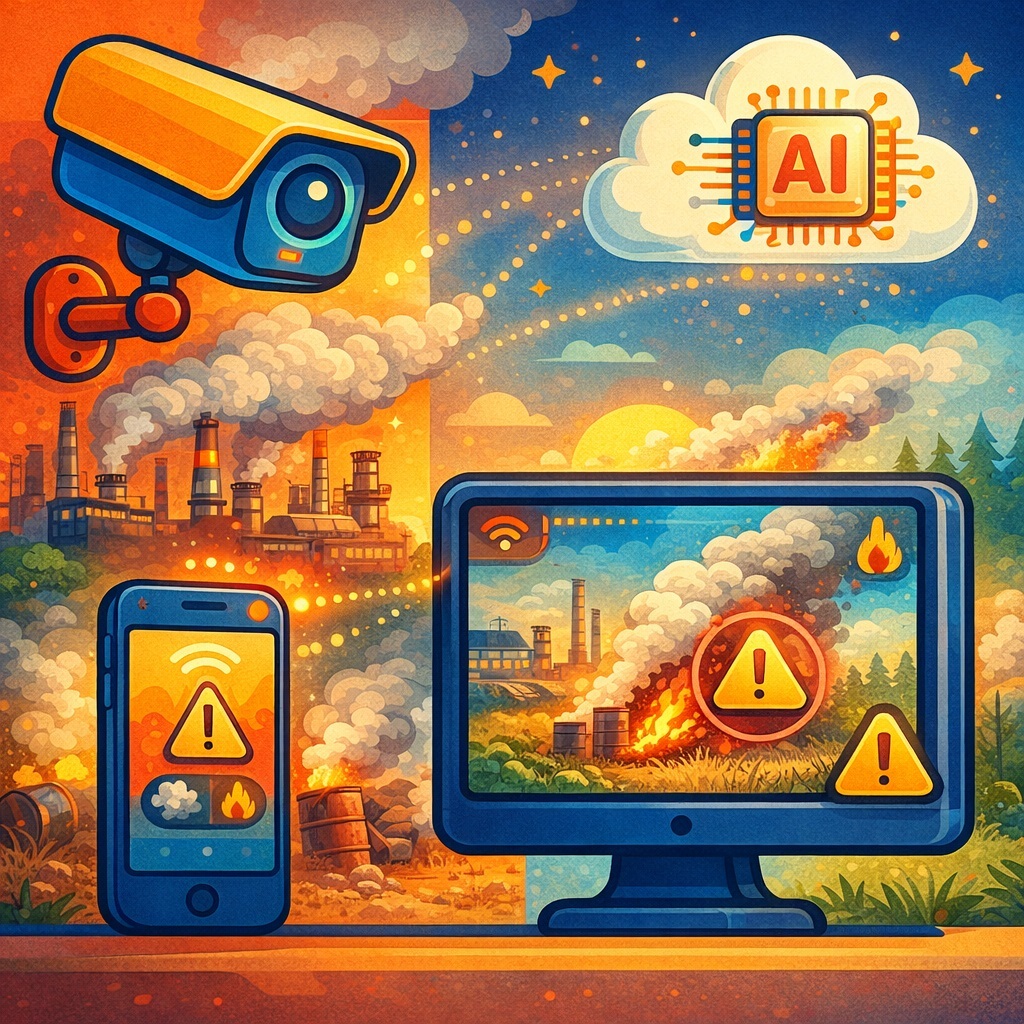
This is where video surveillance with smoke and fire detection stops being just a security system and becomes a tool for environmental monitoring. Cameras begin to see what was previously outside the scope of automation: emissions, flare combustion, smoldering, unauthorized burning, emergency vapors, and fires in open areas.
AI does not replace the environmental specialist or the engineer, but it gives them the most important thing — early visibility. And in environmental safety, reaction time is often more important than the event itself.
Why classical sensors don’t work outdoors
Let’s start with an uncomfortable truth: smoke and gas sensors are excellent… indoors.
In open industrial environments, they have fundamental limitations:
- wind disperses concentrations;
- smoke dissipates before reaching trigger thresholds;
- steam and process emissions “mask” real incidents;
- sensors react too late or do not react at all;
- deploying a dense sensor network is economically unjustified.
Open warehouses, coal and peat piles, oil depots, waste landfills, forest belts around factories, quarries, CHP plant territories, and metallurgical sites — all of these are blind zones for classical automation.
A camera, however, does not measure concentration. It sees changes in the environment.
That is exactly what makes video analytics indispensable for environmental monitoring.
Computer vision as an environmental sensor
Modern smoke and fire detection algorithms do not work on the principle of “saw something gray — alarm.” This is multi-level analytics:
- particle motion dynamics;
- flow shape and direction;
- color and spectral characteristics;
- contrast with the background;
- propagation speed;
- scene context (stack, flare, ground, forest, machinery).
AI learns to distinguish between:
- technological steam vs. combustion smoke;
- welding sparks vs. open flame;
- normal flare combustion vs. emergency emissions;
- dust vs. smoke;
- morning fog vs. actual smoke.
And most importantly, it does this continuously — without fatigue or the “human factor.”
Monitoring stack emissions: from reports to real time
Traditional environmental control of stacks involves:
- periodic measurements;
- laboratory reports;
- paper documentation;
- reaction after the fact.
Video analytics changes the approach:
- the camera captures the visual profile of the emission;
- the algorithm tracks changes in density, color, and shape;
- the system builds time series;
- anomalies are detected at the moment they occur.
What can actually be monitored via video:
- sudden increases in emission density;
- appearance of atypical colors;
- changes in jet direction and speed;
- unsynchronized emissions from neighboring stacks;
- emissions outside the technological cycle;
- nighttime and “quiet” discharges.
This does not replace laboratory measurements. It is an early indicator that allows you to:
- stop a process in time;
- document an incident;
- prove compliance with regulations;
- reduce fines and reputational risks.
Fire detection in open areas
Open-area fires are the most dangerous scenario:
- coal and peat piles;
- waste landfills;
- oil depots;
- recycling warehouses;
- forest belts around industrial sites;
- industrial wastelands.
Here, classical sensors are either absent or useless.
Video analytics solves several problems at once:
- detects smoke at an early stage (before flames appear);
- identifies smoldering;
- recognizes open fire;
- works over long distances;
- scales without laying cables or pipes.
The most effective combination is:
- standard cameras + AI;
- thermal cameras + visual context.
A thermal camera sees temperature. AI understands what it means.
Environment and safety: one system - multiple tasks
The key feature of smoke and fire video detection is multifunctionality.
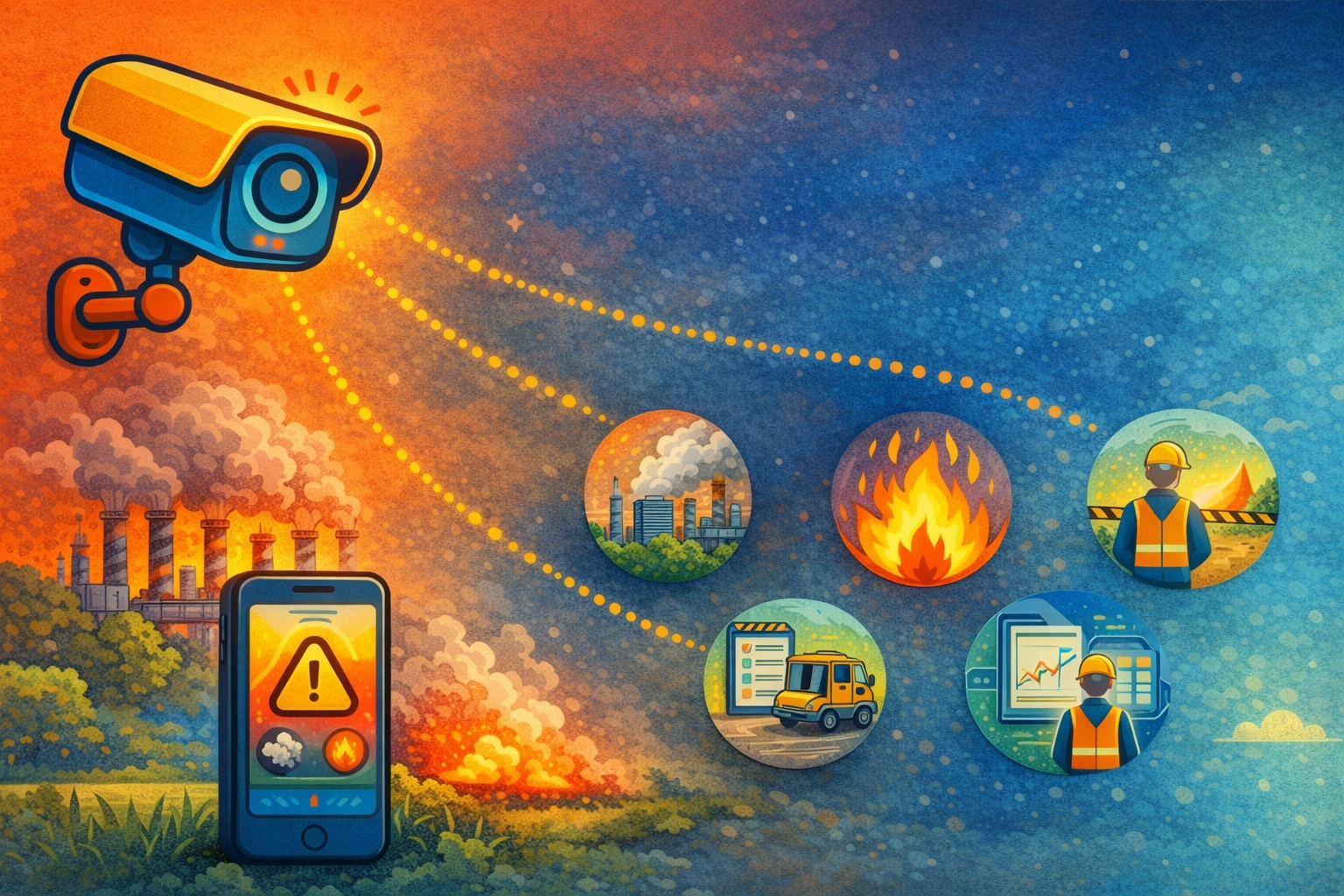
A single camera can simultaneously:
- monitor emissions;
- detect fires;
- track people in hazardous zones;
- record machinery movement;
- identify regulatory violations.
This fully aligns with the modern concept of AI as a layer of understanding rather than a standalone “sensor.”
Instead of dozens of fragmented systems — a single visual platform.
Integration into the industrial ecosystem
Video analytics does not exist in a vacuum. Maximum effect is achieved through integration:
- with corporate ERP systems;
- with environmental monitoring systems;
- with process operation logs;
- with alert and notification systems.
Example scenario:
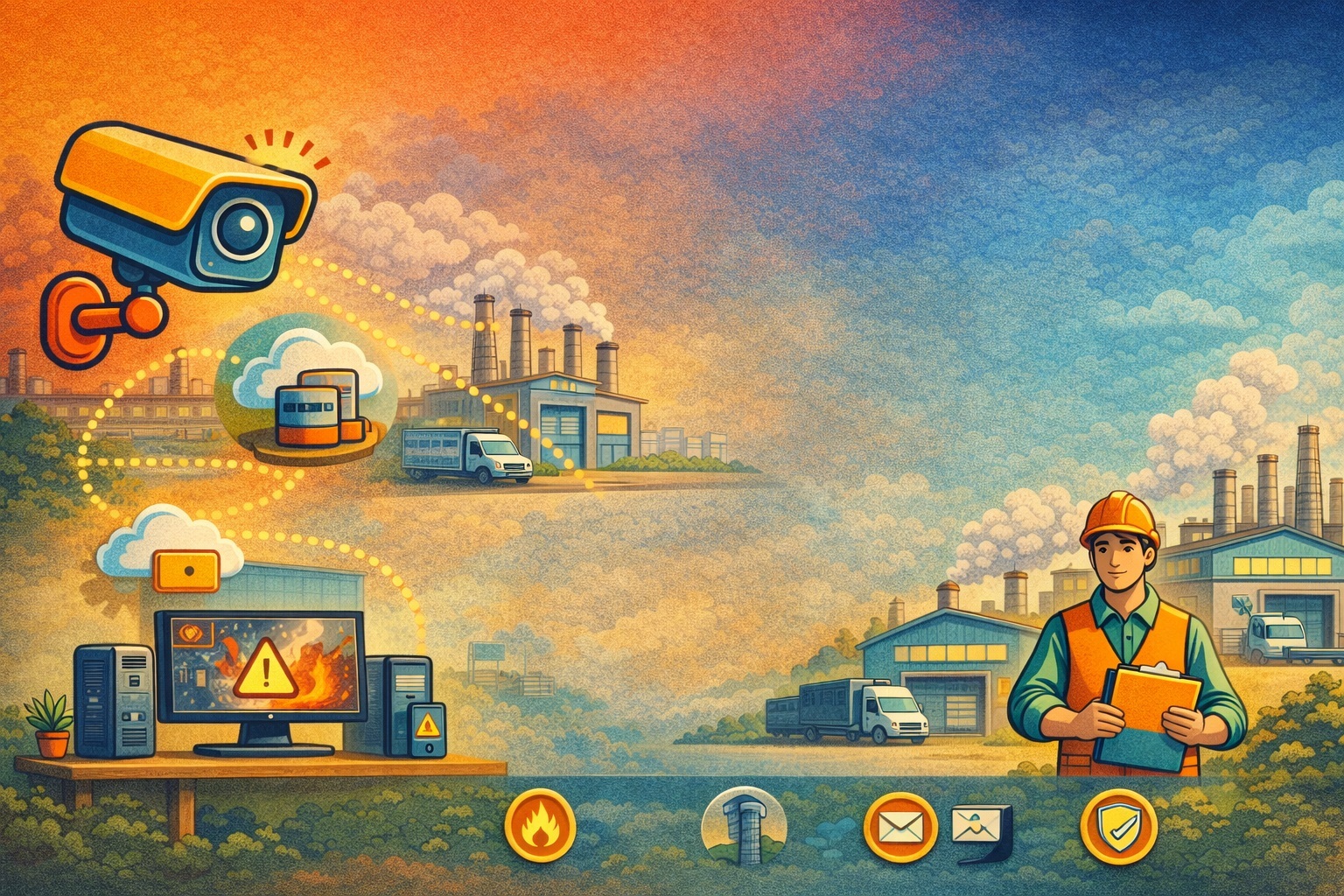
- The camera detects abnormal smoke.
- AI classifies the event.
- The system checks the current equipment mode.
- A notification is generated for:
- the environmental specialist,
- the process engineer,
- the dispatcher.
The event is logged.
If necessary, the process is automatically adjusted.
This is end-to-end analytics — often talked about, rarely implemented.
Fast ROI: why video is the best place to start
Among all AI applications in industry, video analytics:
- requires minimal investment;
- uses existing infrastructure;
- scales via software;
- delivers fast results.
For environmental monitoring, this is especially important:
- a single prevented incident pays for the system;
- fewer fines and inspections;
- improved reporting;
- increased regulator trust.
Small and medium-sized enterprises
A common myth: AI-based environmental monitoring is only for giants.
In practice:
- 2–5 cameras are enough;
- a local server or a regular PC;
- a basic smoke and fire detection model;
- integration with email or a messenger.
Even a small factory or warehouse gains:
- early fire detection;
- emission monitoring;
- an evidence base;
- reduced risks.
Here, AI is not a “grand transformation,” but sensible automation.
False alarms: the main fear and how it’s addressed
The most frequent question: “What if it’s steam? Fog? Dust?”
Modern systems handle this through:
- scene context;
- site-specific training;
- temporal filtering;
- combination of visual features;
- cross-checks with process data.
It’s important to understand: AI is not perfect, but it is trainable. And unlike sensors, its accuracy improves over time.
From observation to prediction
The next stage is forecasting:
- accumulation of emission statistics;
- identification of correlations;
- prediction of emergency modes;
- scenario modeling.
Conclusion: when a camera becomes an environmental specialist
Smoke and fire detection in video surveillance systems is no longer an “additional feature.” It is a new class of environmental sensors that:
- work where traditional sensors remain silent;
- see earlier than automation triggers;
- understand context, not just thresholds;
- combine safety, environmental control, and analytics.
Industry is truly learning to see, think, and predict. And sometimes, all it takes is simply looking more carefully. Where ecology used to be a report, today it becomes a real-time process. And tomorrow — a controllable system in which smoke and fire are not surprises, but signals noticed in time.