
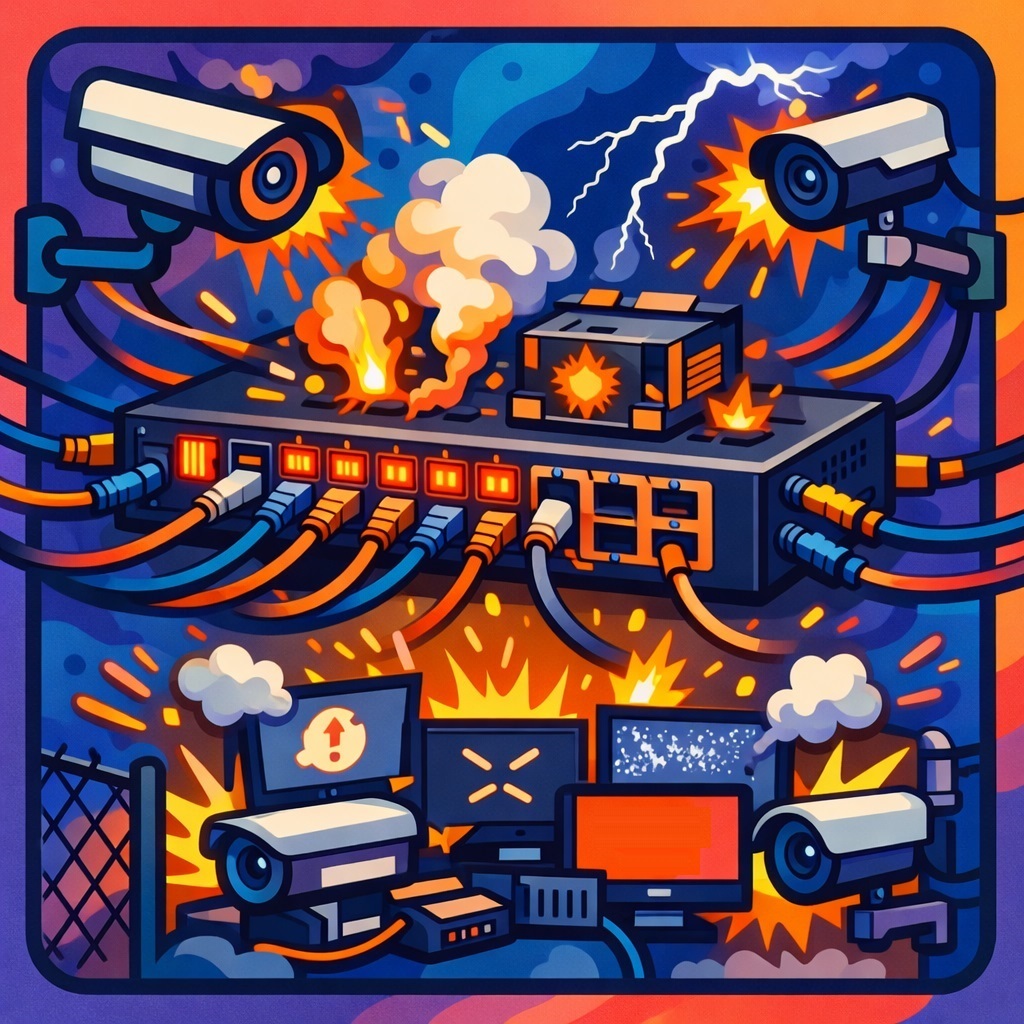
Why PoE became the video-surveillance standard and what people actually love it for
PoE won in video surveillance not because it’s perfect, but because it’s convenient. One cable instead of two solves half the organizational headaches at once. No need to pull separate power to every camera, no need to negotiate outlet locations, no need to explain why the power adapter in the weatherproof box died again from condensation. The camera gets power and data over a single twisted pair, installation speeds up, the diagram gets simpler, and the site is commissioned faster. For the client it looks “high-tech”, for the engineer it looks like common sense.
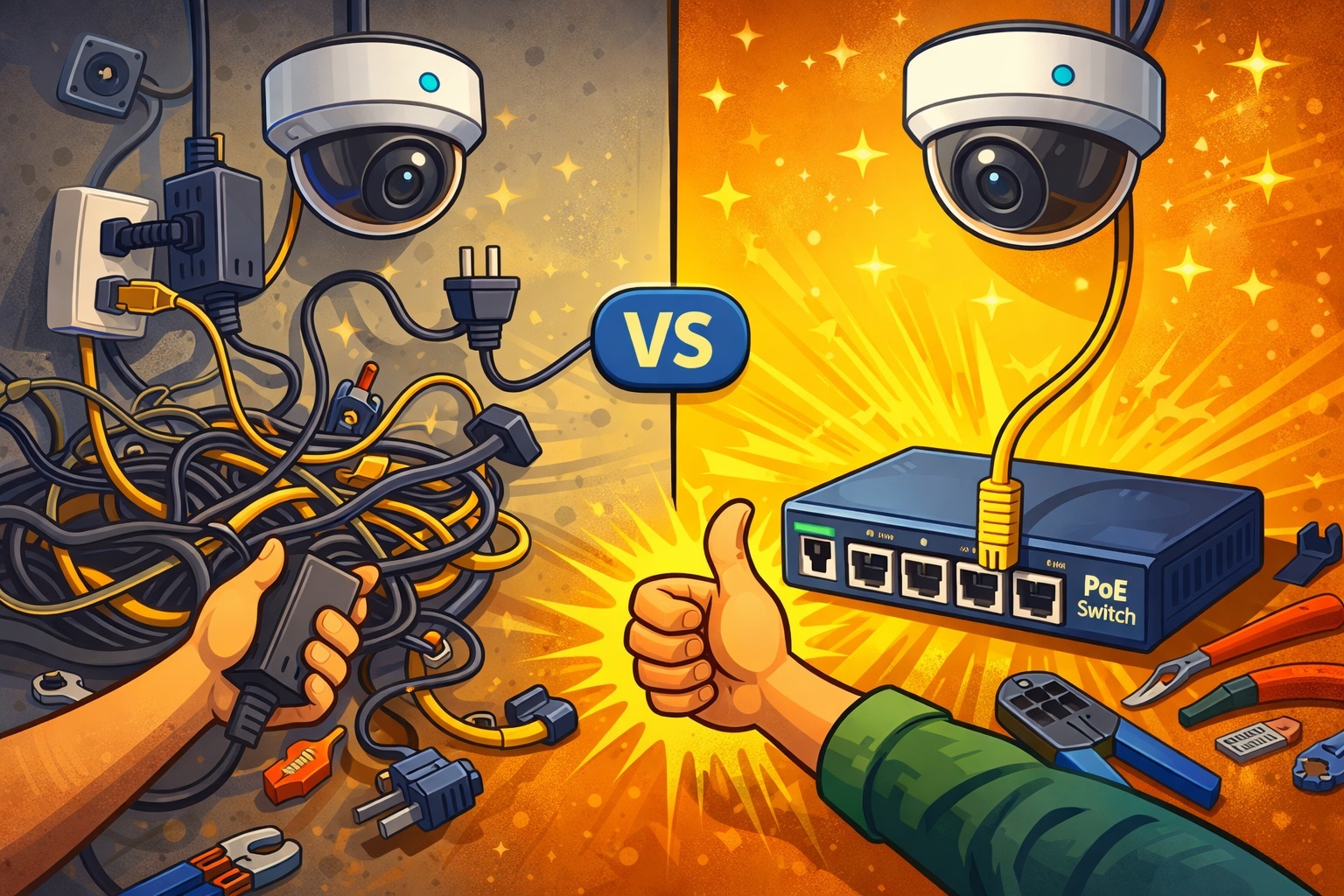
Centralized power is the second big advantage. When all cameras are powered from a PoE switch, you gain real control. You can reboot a camera remotely, see its power draw, and notice when it starts consuming more than normal and is likely to need attention soon. Add a UPS in the rack and you get backup for the whole system at once. Not selective, not partial, but straightforward and predictable. In video surveillance this matters a lot, because cameras love to go down exactly when you don’t want them to.
The third advantage is flexibility and scalability. PoE lets you design a system not as a static structure, but as a living organism. Cameras can be added, moved, or replaced without reworking the electrical side. That’s especially useful during expansions, renovations, and phased commissioning. This is where PoE proves it’s a mature technology, not a temporary workaround.
But there’s a flip side. PoE works extremely well within its assumptions. It doesn’t like being treated as a universal power extension cord. Problems begin the moment convenience replaces calculation.
The third advantage is flexibility and scalability. PoE lets you design a system not as a static structure, but as a living organism. Cameras can be added, moved, or replaced without reworking the electrical side. That’s especially useful during expansions, renovations, and phased commissioning. This is where PoE proves it’s a mature technology, not a temporary workaround.
But there’s a flip side. PoE works extremely well within its assumptions. It doesn’t like being treated as a universal power extension cord. Problems begin the moment convenience replaces calculation.
PoE limitations people remember after the system goes live
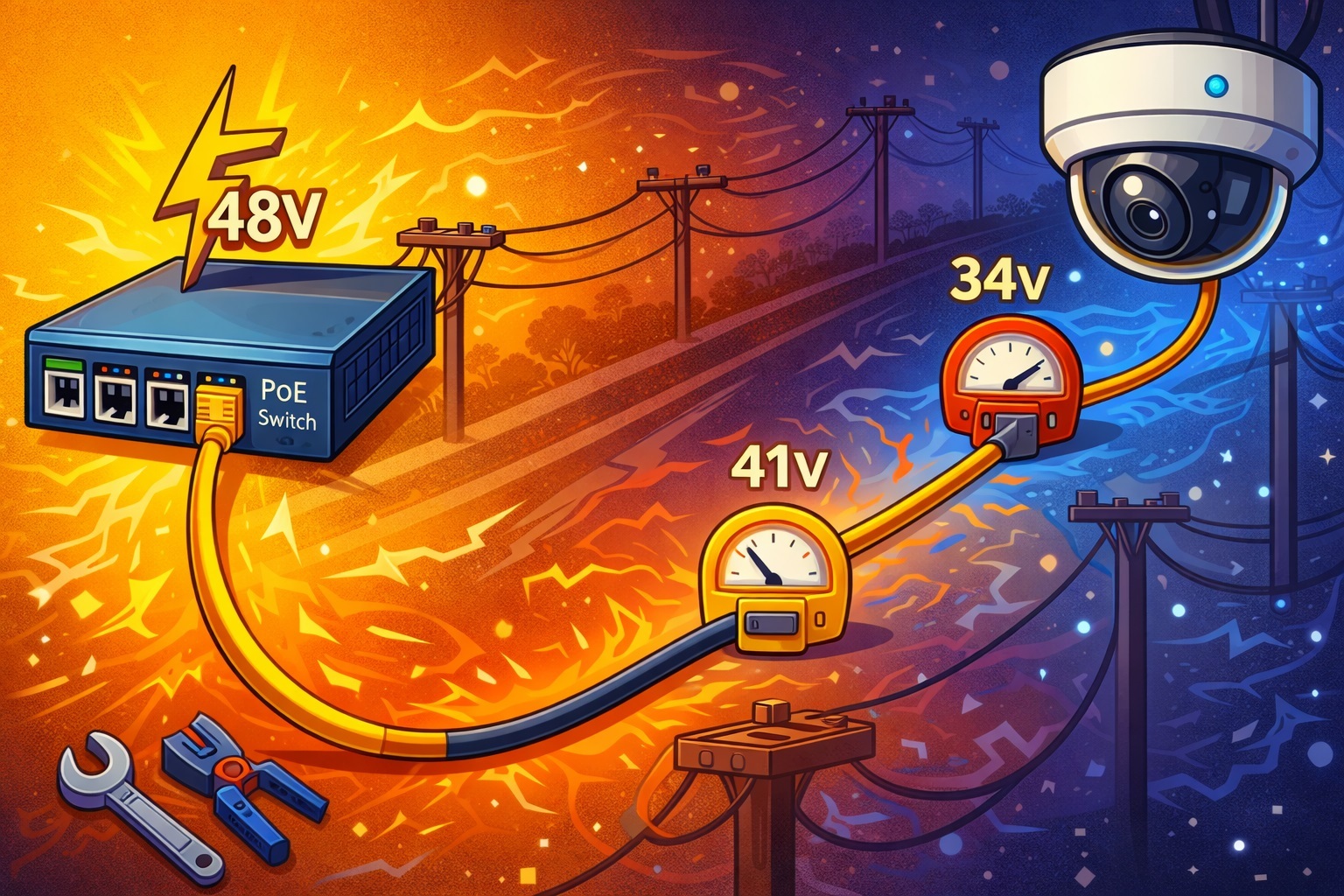
The main limitation of PoE is physics. Ethernet cable has resistance, which means any power delivered through it comes with voltage drop. The longer the run, the lower the voltage at the far end. The poorer the cable, the faster your margin disappears. A camera on a 70-meter run of good copper feels fine. The same camera on 90 meters of questionable cable lives on the edge. On paper it works. In reality it’s constantly balancing between stability and reboot.
The second limitation is power. PoE has clear limits on how much energy it can deliver. Cameras with IR illumination, motorized lenses, and heaters can easily hit peak consumption. In summer you might not notice. In winter everything turns on at once and suddenly it turns out your “headroom” was imaginary. The switch starts limiting power, ports cycle off, cameras reboot. That’s not a failure. That’s normal behavior for a system designed with no reserve.
The third limitation is concentrated failures. A PoE switch becomes a single point of power. Overheating, power-supply degradation, or simply a bad unit can take down a whole group of cameras at the same time. In older designs with individual adapters, failures were distributed. Here they become collective. It’s neither good nor bad, it’s just a fact you have to design around.
The electrical side deserves special attention. PoE runs often go outdoors: cameras on facades, poles, supports. The cable connects different potentials, different grounds, different environments. It starts participating in potential equalization, catching surges and picking up interference. The PoE port in the switch becomes the first thing to take the hit. Sometimes instantly, sometimes gradually. That’s exactly why PoE ports in surveillance deployments tend to age faster than in office networks.
The third limitation is concentrated failures. A PoE switch becomes a single point of power. Overheating, power-supply degradation, or simply a bad unit can take down a whole group of cameras at the same time. In older designs with individual adapters, failures were distributed. Here they become collective. It’s neither good nor bad, it’s just a fact you have to design around.
The electrical side deserves special attention. PoE runs often go outdoors: cameras on facades, poles, supports. The cable connects different potentials, different grounds, different environments. It starts participating in potential equalization, catching surges and picking up interference. The PoE port in the switch becomes the first thing to take the hit. Sometimes instantly, sometimes gradually. That’s exactly why PoE ports in surveillance deployments tend to age faster than in office networks.
Why you should separate the office network from the surveillance network
One of the most underestimated design topics is network separation. Many people assume VLANs are enough: logically separated, checkbox ticked, done. But PoE and electrical phenomena don’t know what a VLAN is. For them there’s only a port and a cable.
When cameras and computers share the same PoE switch, several risks appear immediately. The first is delivering power where it shouldn’t go. Today a camera is plugged into a port, tomorrow someone plugs a PC into the same port. On a managed switch someone forgot to disable PoE. On an unmanaged one you can’t disable it at all. Best case nothing happens. Worst case network cards begin degrading and die later. That’s how “mysterious” issues are born, the ones you won’t catch in logs or tests.
When cameras and computers share the same PoE switch, several risks appear immediately. The first is delivering power where it shouldn’t go. Today a camera is plugged into a port, tomorrow someone plugs a PC into the same port. On a managed switch someone forgot to disable PoE. On an unmanaged one you can’t disable it at all. Best case nothing happens. Worst case network cards begin degrading and die later. That’s how “mysterious” issues are born, the ones you won’t catch in logs or tests.
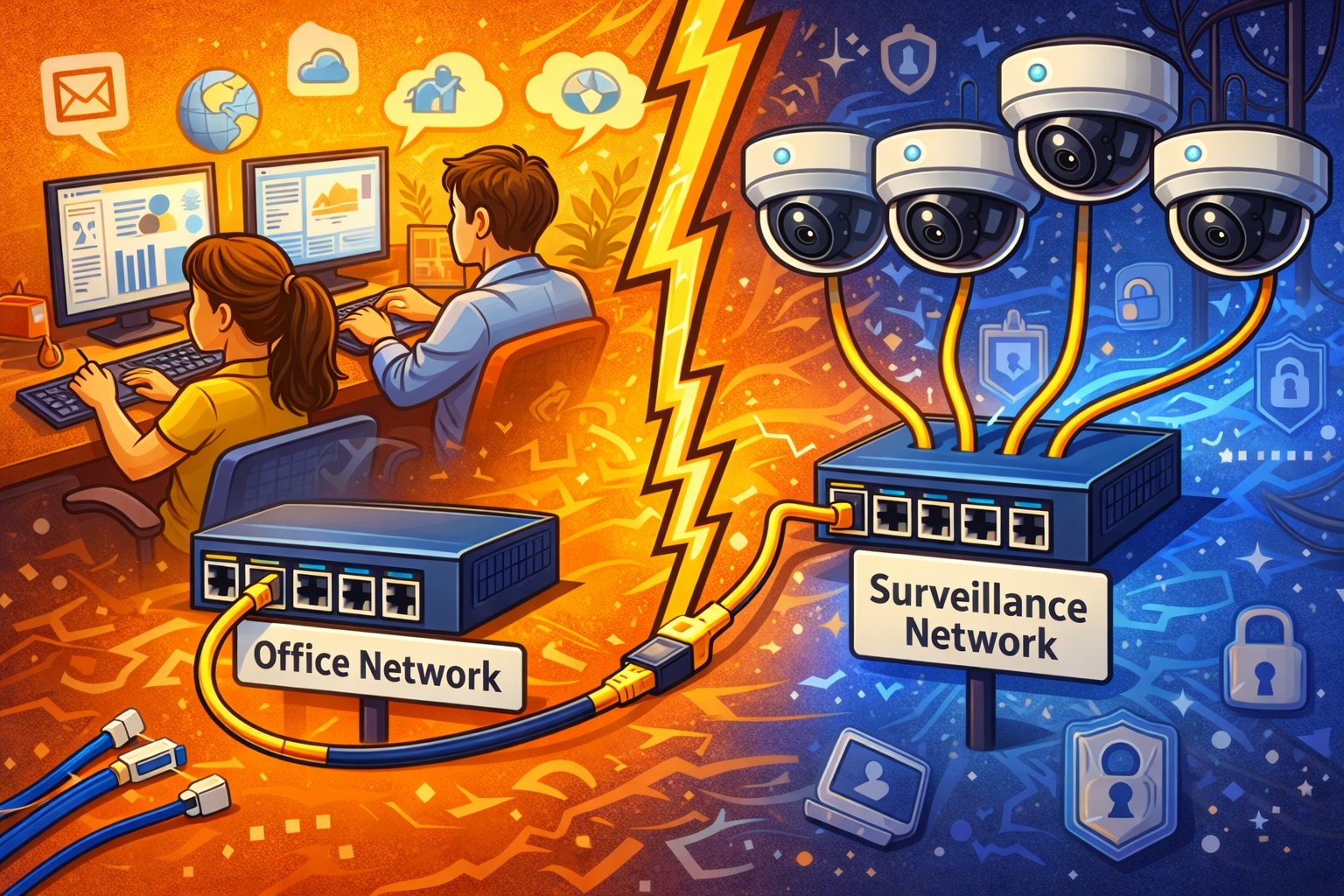
The second risk is the spread of electrical trouble. An outdoor line catches a surge, a potential difference, or induced noise. If video surveillance is physically isolated, the problem stays inside that segment. If everything is on one switch, the impulse can propagate through the entire infrastructure. Office PCs, servers, and printers suddenly become participants in a story they never signed up for.
The third point is operations. A surveillance network and an office network live by different rules. The surveillance network is under constant load, runs 24/7, carries heavy traffic, and has specific requirements. The office network behaves differently. When you merge them, compromises start hurting both sides.
That’s why physical separation isn’t overkill, it’s basic engineering logic. Dedicated PoE switches for cameras, a separate office network, and clean uplinks with no PoE. VLANs can be an add-on, but not a substitute for physical separation.
The third point is operations. A surveillance network and an office network live by different rules. The surveillance network is under constant load, runs 24/7, carries heavy traffic, and has specific requirements. The office network behaves differently. When you merge them, compromises start hurting both sides.
That’s why physical separation isn’t overkill, it’s basic engineering logic. Dedicated PoE switches for cameras, a separate office network, and clean uplinks with no PoE. VLANs can be an add-on, but not a substitute for physical separation.
Typical design mistakes that lead to real problems
Mistake one: PoE budget with no headroom. The most common and, long-term, the most expensive. The system is designed using datasheet power draw, without considering peaks, cable length, and aging. The switch runs at the limit, heats up, ports degrade. A year later you get weird outages no one links back to the initial calculation.
Mistake two: ignoring run length and cable quality. One hundred meters is treated as a “working distance” rather than a limit. Cable is chosen by price, not by copper. The camera “works”, but there is no margin. Any change in conditions triggers instability.
Mistake three: mixing cameras, computers, and uplinks on the same PoE switch. It doesn’t always show up immediately, so it’s considered acceptable. But it’s one of the most common reasons for NIC degradation and “mystery” user issues.
Mistake four: connecting PoE ports to each other. Two PoE switches are linked directly. Sometimes PoE is disabled, sometimes not, sometimes it behaves unpredictably. Even if nothing breaks right away, ports take extra stress and age faster.
Mistake five: using passive PoE. It’s cheap and simple, but it has essentially no protection. One wiring mistake becomes damaged hardware. Passive PoE forgives nothing, ever.
Mistake six: shielded cable with no grounding. Shielding without a proper drain to ground doesn’t protect, it collects noise. Especially outdoors. Especially on long runs. This is a classic mistake that looks like “care about quality” but actually accelerates problems.
Mistake seven: no failure scenarios. Nobody thinks through what happens under overload, when a camera is replaced with a more power-hungry model, or when a PSU fails. The design exists only for commissioning day, not for years of operation.
Mistake two: ignoring run length and cable quality. One hundred meters is treated as a “working distance” rather than a limit. Cable is chosen by price, not by copper. The camera “works”, but there is no margin. Any change in conditions triggers instability.
Mistake three: mixing cameras, computers, and uplinks on the same PoE switch. It doesn’t always show up immediately, so it’s considered acceptable. But it’s one of the most common reasons for NIC degradation and “mystery” user issues.
Mistake four: connecting PoE ports to each other. Two PoE switches are linked directly. Sometimes PoE is disabled, sometimes not, sometimes it behaves unpredictably. Even if nothing breaks right away, ports take extra stress and age faster.
Mistake five: using passive PoE. It’s cheap and simple, but it has essentially no protection. One wiring mistake becomes damaged hardware. Passive PoE forgives nothing, ever.
Mistake six: shielded cable with no grounding. Shielding without a proper drain to ground doesn’t protect, it collects noise. Especially outdoors. Especially on long runs. This is a classic mistake that looks like “care about quality” but actually accelerates problems.
Mistake seven: no failure scenarios. Nobody thinks through what happens under overload, when a camera is replaced with a more power-hungry model, or when a PSU fails. The design exists only for commissioning day, not for years of operation.
How to design a PoE system that lasts for years, not until the first winter
Good PoE design in video surveillance starts with respecting the technology’s limits. Reserve PoE budget should be at least 25–30 percent. Cable runs should be calculated based on real cable, not ideal cable. High-consumption cameras should be treated as a separate category, not as “just another camera”.
Surveillance and office networks should be physically separated. PoE should be delivered only where it’s needed. Uplinks between switches should carry no power. Managed switches should be configured, not left at “default”.
Outdoor lines need protection. Surge protection, fiber, and proper grounding aren’t luxuries, they’re part of the cost of reliability. Shielding should either be correctly grounded or not used at all.
If PoE never reminds you it exists, the designer did everything right. And boredom in video surveillance is the best sign the system was built properly.
Surveillance and office networks should be physically separated. PoE should be delivered only where it’s needed. Uplinks between switches should carry no power. Managed switches should be configured, not left at “default”.
Outdoor lines need protection. Surge protection, fiber, and proper grounding aren’t luxuries, they’re part of the cost of reliability. Shielding should either be correctly grounded or not used at all.
If PoE never reminds you it exists, the designer did everything right. And boredom in video surveillance is the best sign the system was built properly.