
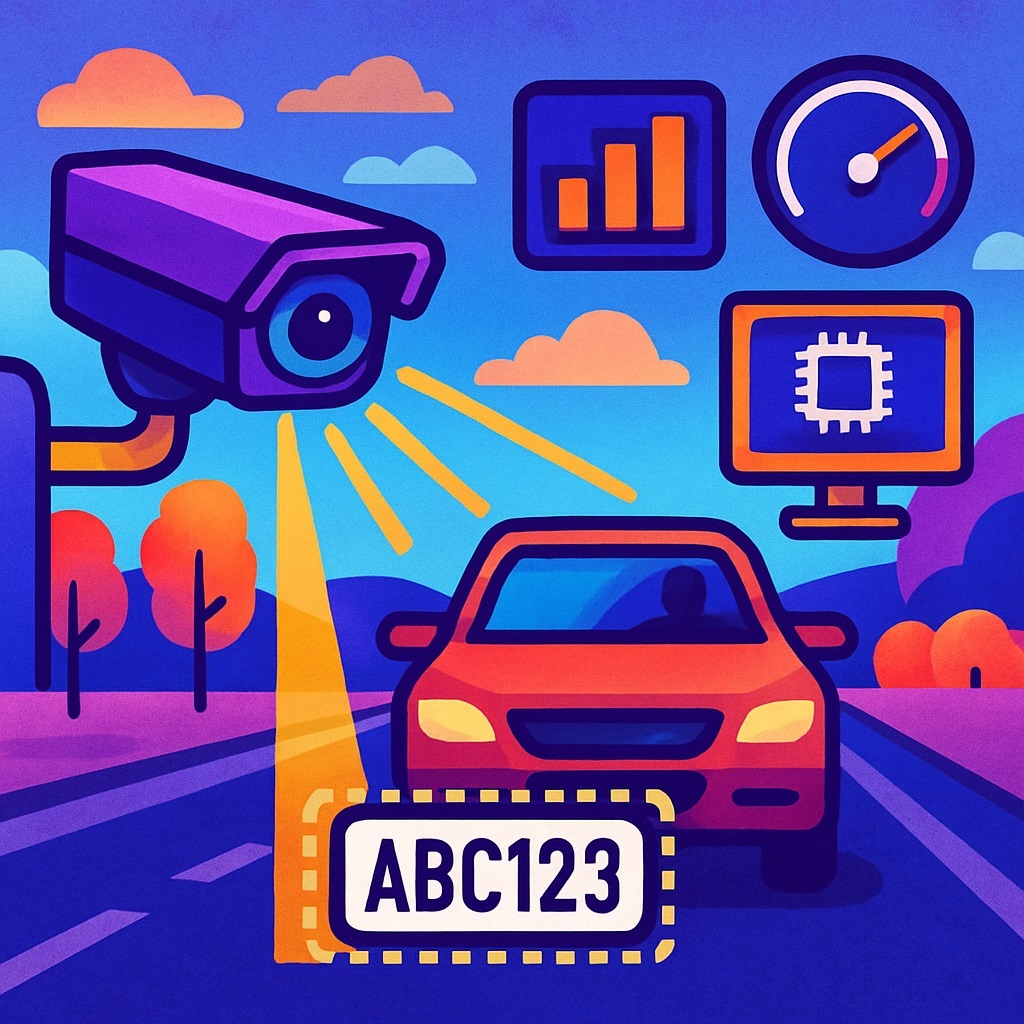
The updated SmartVision 5.2 introduces an improved license plate recognition module, a redesigned motion detector, and an enhanced video player for archive playback. The changes focus on increasing accuracy, stability, and performance when handling multiple streams and cameras.
License Plate Recognition: Different Models for Different Regions
The main update is the new LPR module. The system now uses separate neural network models for European, American, and east-european license plates. This improves recognition accuracy in real-world scenarios, where fonts, layouts, and formats vary by country.
For Russian plates, a specialized model has been added to handle the unique format of the last 2–3 digits (regional codes). The system automatically detects the country and applies the appropriate model.
New parameters have also been added to the ini-file, allowing for flexible fine-tuning of recognition algorithms. CPU optimization reduces load when processing multiple streams simultaneously.
Motion Detection and Video Streaming
The neural network–based motion detector has been significantly redesigned. It is now more accurate and better responds to real changes in the frame, while the number of false positives has decreased.
An issue affecting live viewing of some high-resolution IP camera streams has been fixed. The buffer size for these cameras has been increased to improve stability.
For archived footage, the updated SmartVision Player offers more convenient navigation through recorded video.
Factors Affecting Recognition Accuracy
LPR accuracy depends not only on algorithms but also on capture parameters:
- Proper camera positioning
- Frame rate (FPS)
- Lighting conditions
- System performance
Higher frame rates increase the likelihood of accurate recognition but also raise CPU load. If the camera is placed too close and the vehicle is moving quickly, the system may capture only a single frame of the plate, resulting in a failed recognition attempt.
The algorithms analyze multiple frames, use per-character error probabilities, and apply vehicle tracking to avoid confusion when multiple cars are in view.
Example: Distance Traveled in One Second
- 20 km/h — 5.56 m
- 40 km/h — 11.11 m
- 60 km/h — 16.67 m
- 120 km/h — 33.33 m
- 200 km/h — 55.56 m
If a plate remains in view for less than one second, the system may not collect enough data for a reliable result. This can be addressed either by adjusting recognition parameters (reducing the required number of matches) or by changing the camera’s angle and placement.
Version 5.2 improves accuracy and stability without changing the core architecture. The added neural network models, CPU optimizations, and updated tools make the system more reliable in multi-stream, high-load environments. This release is designed for practical use in real-world video surveillance deployments.
Download SmartVision here
Download SmartVision here